
C QUAND
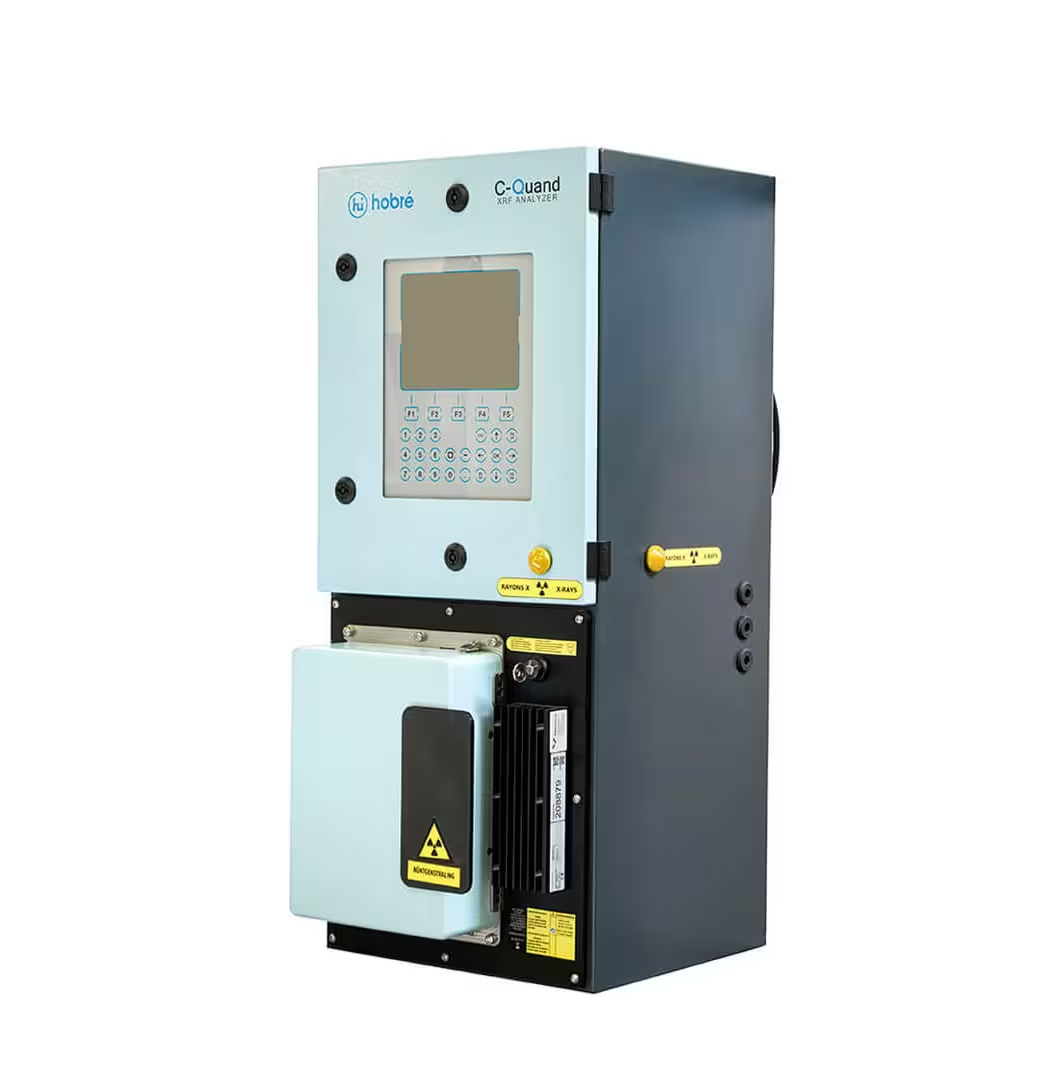
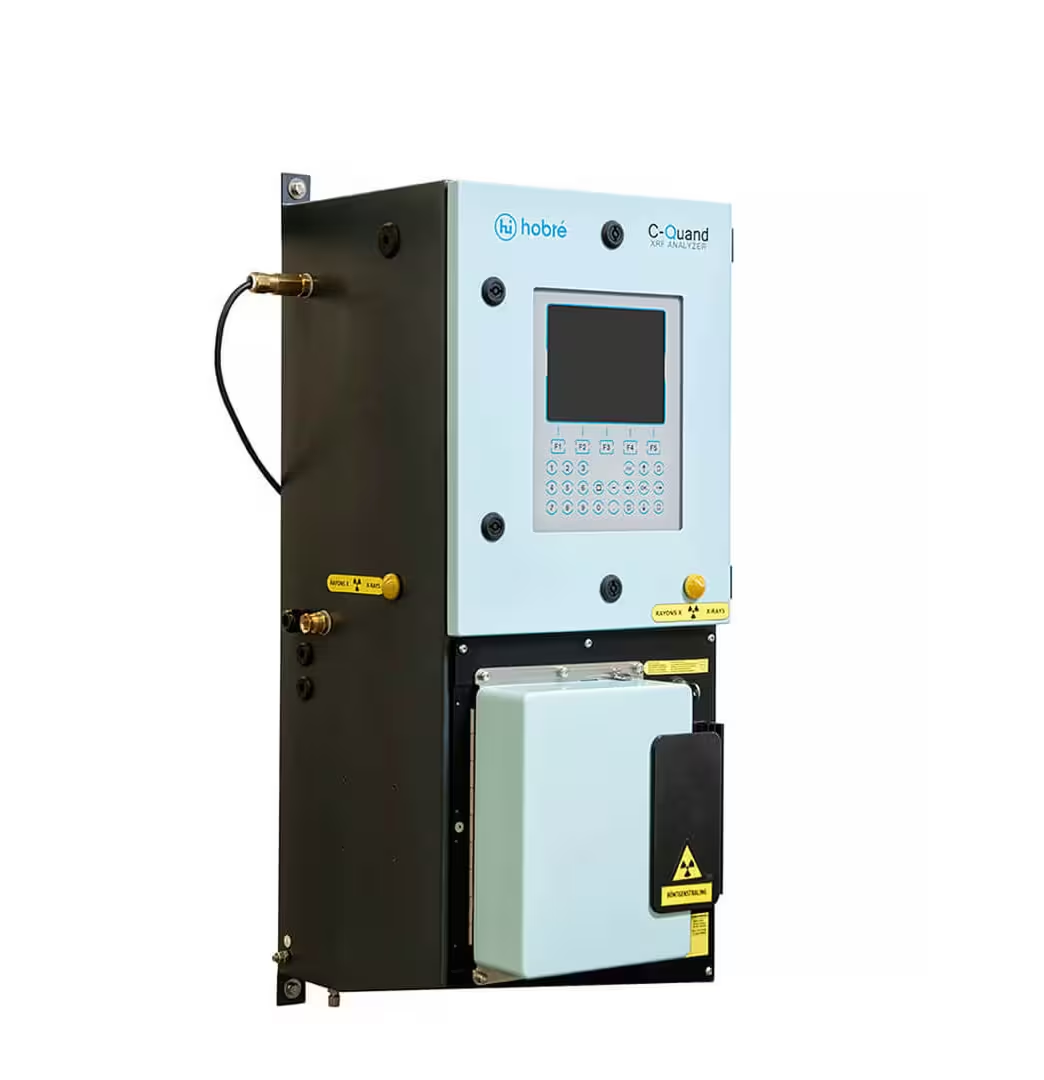
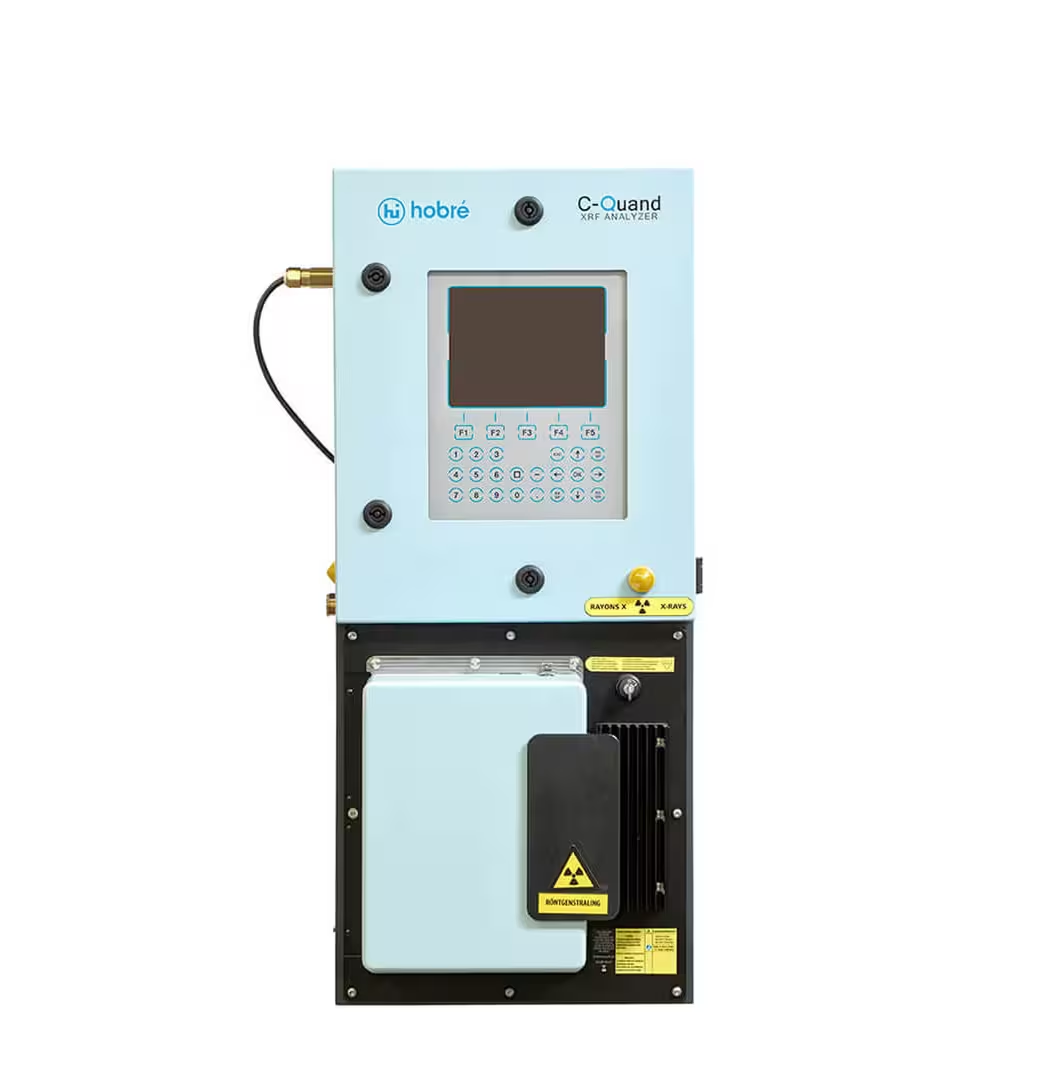
The C-QUAND is a sensitive yet robust, easy to operate & maintain, continuous process analyzer which will enable the optimization of your plant process. With its broad range from Silicon (Z=14) to Uranium (Z=92), the C-QUAND comes into its own in various applications such Total Sulphur measurement, salt-in-crude oil, chlorine in sour water, metals in crude oil and SAF/HVO production, and many other applications (please consult factory).




Key Benefits
- Continuous multi-element analysis
- Close to no maintenance
- Automated zero and span correction
- Suitable for hazardous and harsh area’s
- Consistent with ASTM and ISO
- 24/7 support through remote access
- Long life SDD and X-Ray tube
C QUAND
Product Comparison
In the table below, you may find the differences of the two C-QUAND variants available:
Applications
Catalyst measurement in PIA and PTA Plants
Metals refining and recycling
Total Sulphur measurement in fuels
Waste water streams
More Information
Our Technology
The non-destructive ED-XRF, X-Ray method has a long-proven track record in the industry for the measurement of elements in liquids. The technology delivers low OPEX costs with high availability (>99.5%). The C-QUAND analyzer offers excellent repeatability with the guarantee of drift-free measurement in the low and high concentration ranges.
The C-QUAND – which has no problematic moving parts – features integrated auto-validation on a solid reference material. The heated sample cell handles more viscous samples and measures at process temperature. Both the sampling system and analyzer wetted parts are available in acid resistant materials. The net effect is a continuous, non-destructive, low maintenance analyzer with calibration intervals of typically more than one year. Considerable savings in analysis time and operational cost – in comparison to alternative analytical techniques – are two of the main benefits of the C-QUAND. It is a robust product fit for harsh process environments and can be fully integrated in process monitoring and control.
X-Ray Fluorescence Principle
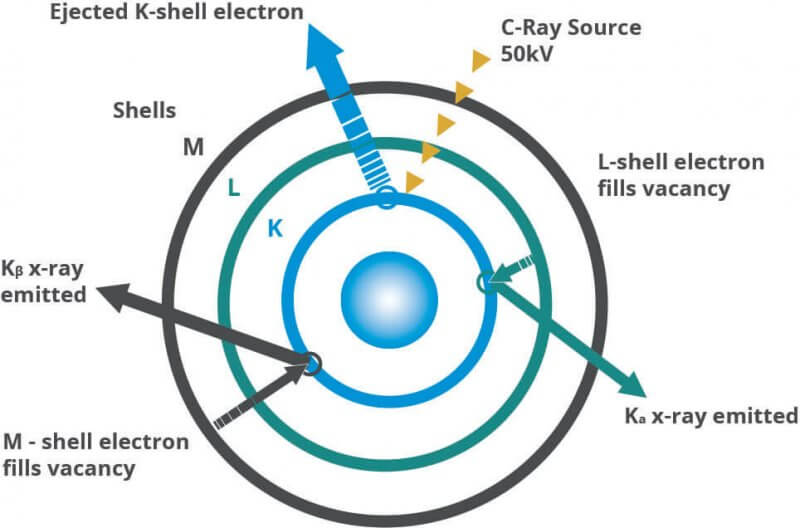
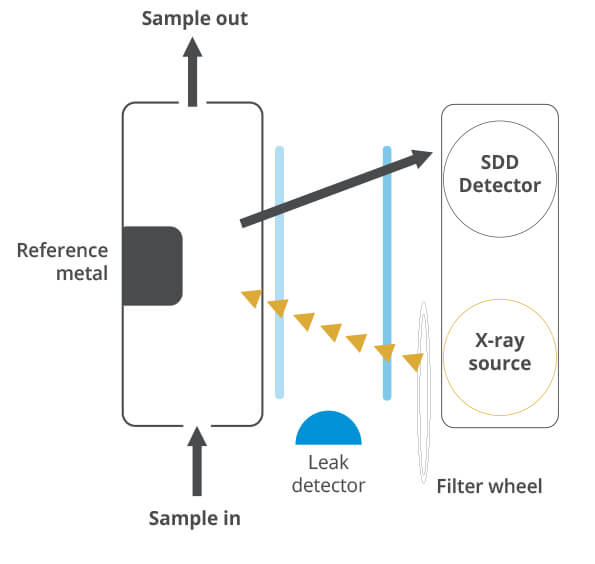
The C-QUAND has a powerful 15 watt, 50 kV X-ray source, with a silver anode. The X-rays displace the inner electron out from the K or L orbit of the atom, leaving a void. The now unstable atom will immidiately fill the void with an electron from the outer orbits. The resulting reduction in energy is emitted as a photon with a specific energy level unique to that particular element. The fluorescence is captured by a silicon drift detector (SDD). It’s count rate being monitored directly proportional to the concentration of the element of interest.
Measuring cell
The X-rays generated by the source are first filtered by one of six different optical filters. The X-rays then travel through a thin window before hitting the actual sample. The window material can be beryllium for sulfur measurement in hydrocarbons, or a polyimide such as Kapton® or Upilex® for the measurement of metals in aqueous solutions.
The measuring cell is constantly flushed with fresh samples. Importantly, this method of measurement is continuous throughout the entire measurement, not just at the beginning. The measuring cell also contains a solid reference metal, which is used for automatic gain correction.
Technical Specification
Questions? Our expert is ready for you
.avif)
Products you might also like

Ready to measure what matters?
Talk to our team about what Hobré can do for your operation. No pressure, no jargon.
